McLeod County Dog Registration Information
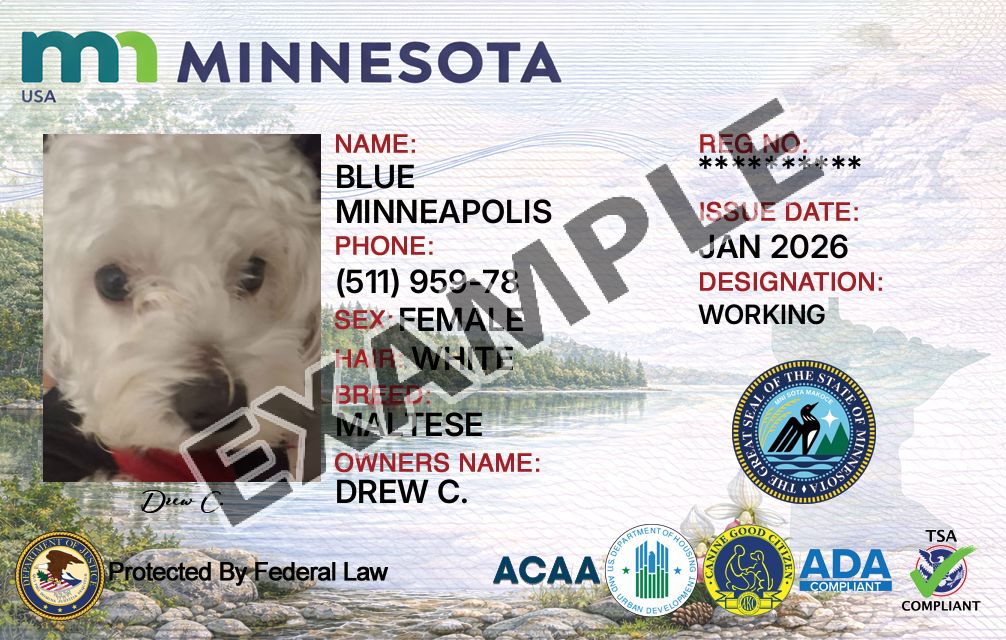
Service Dogs and Emotional Support Animals in McLeod, Minnesota
If you’re searching where do I register my dog in McLeod County, Minnesota for my service dog or emotional support dog, the most important thing to know is that “registration” usually means one of two things: (1) getting a dog license in McLeod County, Minnesota (often handled by your city or township), and/or (2) keeping the right documentation for your dog’s status (service dog or emotional support animal). These are separate issues with different rules.
Where to Register or License Your Dog in McLeod County, Minnesota
Dog licensing rules can vary by municipality. If you live within city limits, you may license through your city. If you live outside city limits (township/rural), you may need to confirm the correct licensing authority with the county or your local township clerk. Below are official public offices that serve McLeod County residents.
McLeod County Government Center (County Government Offices)
- Phone: (320) 864-5551
- Hours: Monday–Friday, 8:00 AM – 4:30 PM
City of Hutchinson (Animal Control / City Licensing Information)
- Phone: (320) 587-5151
City of Glencoe (City Offices / Licensing Information)
- Phone: (320) 864-5586
- Email: info@ci.glencoe.mn.us
- Hours: Monday–Friday, 8:00 AM – 4:00 PM
Overview of Dog Licensing in McLeod County, Minnesota
What “registering a dog” typically means locally
In many Minnesota communities, “registering” a dog refers to getting a local dog license (sometimes called a dog tag). Licensing is usually handled by the city if you live within city limits. If you live in a township or unincorporated area, requirements may be different and can be managed at a different local level.
Why local governments require licensing
- Public health: licensing commonly ties to rabies vaccination compliance.
- Identification: a tag can help return a lost dog faster.
- Animal control administration: supports local animal services and enforcement of local ordinances.
Licensing vs. service dog or ESA status
A dog license is a local requirement about pet ownership. A service dog’s legal protections come from disability law. An ESA’s housing-related protections (when they apply) come from fair housing rules and documentation—none of these are created by a single “service dog registry” or “ESA registry.”
What You Need Before Registering a Dog
Common documentation requested for a dog license
Specific dog licensing requirements in McLeod County, Minnesota can vary by city or township, but many local offices commonly ask for:
- Proof of current rabies vaccination (certificate from a licensed veterinarian)
- Owner identification (and sometimes proof of residency/address within that jurisdiction)
- Spay/neuter documentation (if the local fee structure differs for altered pets)
- Payment of the licensing fee (amount and renewal schedule vary locally)
Rabies vaccination is a common prerequisite
Many local licensing systems require that your dog’s rabies vaccination is current for at least the term of the license. If you recently vaccinated your dog, keep a copy of the vaccination certificate available for the office processing your license.
Steps to Register or License a Dog in McLeod County, Minnesota
Step 1: Identify your licensing authority (city vs. township)
- If you live inside city limits: contact your city offices (examples listed above: Hutchinson or Glencoe) for the dog license process.
- If you live outside city limits: contact your township clerk or start with the McLeod County Government Center to confirm where licensing is handled for your address.
Step 2: Gather your documents
- Rabies vaccination certificate (current)
- Any required owner ID/residency documentation
- Spay/neuter documentation if it affects fees
Step 3: Apply and pay the fee
You may be able to apply in person or through the office’s usual administrative process (procedures vary). Ask the office:
- How long the license is valid (annual vs. multi-year)
- Whether there are late fees or renewal deadlines
- How tags are issued and replaced if lost
Step 4: Keep proof for your records
Keep a copy of the issued license/tag number and your rabies certificate. This is helpful if your dog is lost, if you move within the county, or if you need to update information with your local office.
Service Dog Laws in McLeod County, Minnesota
No universal federal “service dog registration”
Service dogs are not made “official” by a universal federal registry. In practice, a service dog is defined by function: a dog individually trained to do work or perform tasks for a person with a disability. Local dog licensing (if required where you live) is still typically required, even if the dog is a service dog.
How service dog status interacts with local licensing
- Licensing: A dog license in McLeod County, Minnesota (city/township-specific) is about local compliance and identification.
- Access: Public access rights depend on service dog status and behavior standards, not a license tag.
- Vaccination: Proof of rabies vaccination may still be required for local licensing, and is commonly required for public health reasons.
Practical tip for residents
If you’re asked “where to register a service dog,” what many offices actually mean is: “Where do I obtain the local dog license tag?” Start with your city (if you live in city limits) or verify the correct authority through the McLeod County Government Center.
Emotional Support Animal Rules in McLeod County, Minnesota
No universal federal “ESA registration”
Like service dogs, emotional support animals are not registered through a universal federal government registry. An ESA is generally an animal that provides comfort by being with a person, and ESA status is most commonly relevant in housing contexts (for example, requesting a reasonable accommodation under applicable fair housing rules).
How ESA status interacts with local dog licensing
- Local license: If your city/township requires a dog license, your ESA is typically licensed the same way as any other dog.
- Vaccination records: Proof of rabies vaccination may still be required to obtain the local license.
- Housing documentation: If you need an ESA accommodation, the key piece is typically appropriate documentation supporting the need for the accommodation (handled through the housing provider’s process), not a dog license tag.
If your landlord asks for “registration”
Clarify whether they mean: (1) the local dog license required by your city/township, or (2) documentation related to an accommodation request. These are different, and the correct next step depends on what is being requested.
Dog License vs. Service Dog vs. Emotional Support Animal (Comparison)
| Category | Dog License (Local) | Service Dog | Emotional Support Animal (ESA) |
|---|---|---|---|
| What it is | A local license/tag issued by a city or other local authority for dogs living in that jurisdiction. | A dog individually trained to perform tasks for a person with a disability. | An animal that provides comfort/support; mainly relevant to housing accommodations when applicable. |
| Where you “register” | Usually your city (if in city limits) or other local authority; varies within McLeod County. | No universal federal registry; status is based on training/tasks and disability law definitions. | No universal federal registry; status is based on housing accommodation needs and documentation when applicable. |
| Rabies proof commonly required? | Often yes, to obtain or renew a local license. | Local licensing may still require rabies proof; public health requirements still apply. | Local licensing may still require rabies proof; public health requirements still apply. |
| Public access rights | No (a license tag does not grant public access to non-pet places). | Yes, when the dog meets legal definitions and is under control. | No (ESA status generally does not provide broad public access rights). |
| Common local contact in McLeod County | City offices/animal control for your municipality; county government can direct you if unsure. | Local offices handle licensing, but service dog status itself is not issued by the county. | Local offices handle licensing, but ESA status is typically addressed through housing accommodation processes. |
Frequently Asked Questions
Do I need a dog license in McLeod County, Minnesota if my dog is a service dog?
Possibly, yes. A service dog’s legal status is separate from local licensing. If your city or local jurisdiction requires dog licensing, the requirement may still apply. Contact your city office (or township clerk) to confirm local rules and whether any fee waivers exist.
Do I need to “register” my emotional support dog with the county?
Typically, no universal “ESA registration” exists through the county. If your local jurisdiction requires a dog license, your dog may still need to be licensed like any other dog. ESA-related documentation is usually handled as part of a housing accommodation request (when applicable), not through a county dog registry.
What if I live in rural McLeod County (outside any city limits)?
Rules can differ by township. If you’re not sure who issues dog licenses for your address, contact the McLeod County Government Center and ask which local authority handles dog licensing where you live.
What documents do I usually need to license my dog?
Many offices require proof of current rabies vaccination. Some also ask for ID/residency proof, and spay/neuter documentation if fees differ. Requirements and fees can vary by municipality, so confirm with your local licensing office.
Register A Dog In Other Minnesota Counties
Select your county below to get started with your dog’s ID card. Requirements and license designs may vary by county, so choose your location to see the correct options and complete your pup’s registration.
- Aitkin County Dog Registration
- Anoka County Dog Registration
- Becker County Dog Registration
- Beltrami County Dog Registration
- Benton County Dog Registration
- Big Stone County Dog Registration
- Blue Earth County Dog Registration
- Brown County Dog Registration
- Carlton County Dog Registration
- Carver County Dog Registration
- Cass County Dog Registration
- Chippewa County Dog Registration
- Chisago County Dog Registration
- Clay County Dog Registration
- Clearwater County Dog Registration
- Cook County Dog Registration
- Cottonwood County Dog Registration
- Crow Wing County Dog Registration
- Dakota County Dog Registration
- Dodge County Dog Registration
- Douglas County Dog Registration
- Faribault County Dog Registration
- Fillmore County Dog Registration
- Freeborn County Dog Registration
- Goodhue County Dog Registration
- Grant County Dog Registration
- Hennepin County Dog Registration
- Houston County Dog Registration
- Hubbard County Dog Registration
- Isanti County Dog Registration
- Itasca County Dog Registration
- Jackson County Dog Registration
- Kanabec County Dog Registration
- Kandiyohi County Dog Registration
- Kittson County Dog Registration
- Koochiching County Dog Registration
- Lac qui Parle County Dog Registration
- Lake County Dog Registration
- Lake of the Woods County Dog Registration
- LeSueur County Dog Registration
- Lincoln County Dog Registration
- Lyon County Dog Registration
- Mahnomen County Dog Registration
- Marshall County Dog Registration
- Martin County Dog Registration
- Meeker County Dog Registration
- Mille Lacs County Dog Registration
- Morrison County Dog Registration
- Mower County Dog Registration
- Murray County Dog Registration
- Nicollet County Dog Registration
- Nobles County Dog Registration
- Norman County Dog Registration
- Olmsted County Dog Registration
- Otter Tail County Dog Registration
- Pennington County Dog Registration
- Pine County Dog Registration
- Pipestone County Dog Registration
- Polk County Dog Registration
- Pope County Dog Registration
- Ramsey County Dog Registration
- Red Lake County Dog Registration
- Redwood County Dog Registration
- Renville County Dog Registration
- Rice County Dog Registration
- Rock County Dog Registration
- Roseau County Dog Registration
- Scott County Dog Registration
- Sherburne County Dog Registration
- Sibley County Dog Registration
- St. Louis County Dog Registration
- Stearns County Dog Registration
- Steele County Dog Registration
- Stevens County Dog Registration
- Swift County Dog Registration
- Todd County Dog Registration
- Traverse County Dog Registration
- Wabasha County Dog Registration
- Wadena County Dog Registration
- Waseca County Dog Registration
- Washington County Dog Registration
- Watonwan County Dog Registration
- Wilkin County Dog Registration
- Winona County Dog Registration
- Wright County Dog Registration
- Yellow Medicine County Dog Registration